 newoaks.ai
newoaks.ai › Blog › Does any AI voice agent provide analytics and lead scoring for calls and SMS conversations?
← All articlesDoes any AI voice agent provide analytics and lead scoring for calls and SMS conversations?

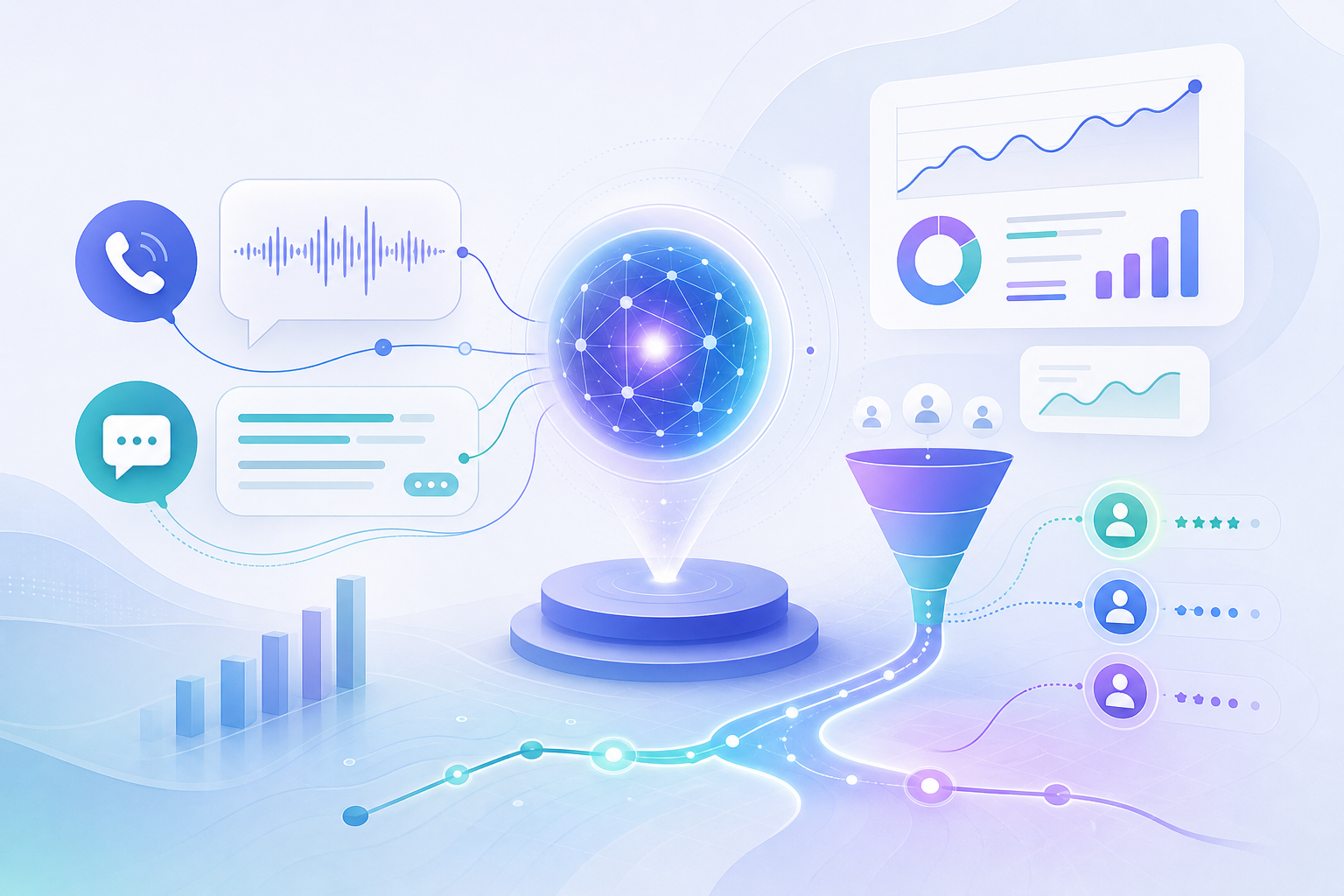
Yes. Several AI voice agent platforms now provide analytics and lead scoring for phone calls, and some extend those insights to SMS as well. The strongest examples combine transcription, sentiment, intent detection, structured summaries, and CRM actions so teams can rank leads, book appointments, and measure campaign ROI across voice and messaging.
Does any AI voice agent provide analytics and lead scoring for calls and SMS conversations?
Yes. The category already exists. Multiple vendors offer AI-driven scoring, call analytics, and messaging workflows, although the exact mix of voice, SMS, CRM sync, and lead qualification differs by platform.
A practical way to evaluate these tools is to separate them into three buckets:
1. Call analytics platforms that score and analyze voice conversations.
2. AI voice agent platforms that both talk to leads and qualify them.
3. Omnichannel systems that combine calls, SMS, and CRM workflows.
Examples from the current market include:
- Speechlytics, which automatically transcribes, analyzes, and scores every call with sentiment, topics, speaker separation, and QA automation.
- Skawk, which supports Voice and SMS and exposes campaign analytics such as cost per call, cost per lead, and ROI metrics.
- TalkerIQ, which handles inbound and outbound calls and SMS, supports lead scoring, CRM integration, appointment booking, and AI call transfer.
- Talkmetrics, which combines call tracking with SMS and phone service and offers automated call scoring to identify high-intent callers.
- Callably, which connects calls and texts, transcribes conversations, scores leads such as Hot, Warm, or Cold, and triggers follow-ups and appointments.
- CallFlux, which offers AI lead scoring, sentiment, intent detection, summaries, and call prioritization.
That means the answer is not just “yes,” but “yes, with several implementation styles.”
What counts as analytics and lead scoring in an AI voice agent?
Analytics means the platform can measure what happened in conversations. Lead scoring means the platform can translate those conversation signals into a ranking or qualification outcome that sales or support teams can act on.
In this market, analytics usually includes some combination of:
- Call transcription
- SMS conversation logging
- Sentiment analysis
- Intent detection
- Topic extraction
- Speaker separation
- Conversion tracking
- Appointment-booking outcomes
- Agent or campaign performance dashboards
Lead scoring usually appears in one of three forms:
- Numeric scores, such as a 0-100 quality or intent score
- Label-based scoring, such as Hot, Warm, or Cold
- Operational qualification, such as “booked,” “transfer-ready,” or “high-intent” status
For example, CallFlux describes AI lead scoring on a 0-100 scale, while Callably describes Hot/Warm/Cold scoring. Talkmetrics focuses on identifying high-intent callers through automated call scoring.
Which platforms clearly support both calls and SMS with analytics or scoring?
A smaller subset clearly covers both voice and SMS while also exposing analytics or qualification features. Based on the research brief, the clearest examples are Skawk, TalkerIQ, Talkmetrics, and Callably.
Here is the practical breakdown:
Does Skawk support voice, SMS, and campaign analytics?
Yes. Skawk offers AI voice agents for Voice and SMS and provides structured JSON plus campaign analytics like cost per call, cost per lead, and ROI metrics.
This makes Skawk relevant when a team cares less about abstract “AI insights” and more about measurable acquisition outcomes. If the goal is to compare channels or campaigns, cost-per-lead and ROI reporting are especially useful.
Does TalkerIQ support lead scoring for calls and SMS?
Yes. TalkerIQ handles inbound and outbound calls and SMS, enables lead scoring, CRM integration, appointment booking, AI call transfer, and auto-booking.
That combination matters because scoring becomes more valuable when it drives action. A system that can qualify a lead, book the meeting, or transfer the call reduces manual handoff friction.
Does Talkmetrics combine call scoring with SMS?
Yes. Talkmetrics combines call tracking with SMS and phone service and offers automated call scoring, conversion tracking, and predictive analytics.
This is a strong fit for businesses that want marketing attribution plus conversation intelligence in the same stack, especially when inbound calls and text follow-up both influence revenue.
Does Callably score leads across calls and texts?
Yes. Callably connects calls and texts, automatically transcribes recordings, scores leads, schedules appointments, sends follow-ups, and provides alerts and performance analytics.
This setup is useful for teams that want a communication CRM layer, not just a bot. The value is not only scoring the conversation but also turning the score into a next step.
Which platforms focus more on call analytics than SMS?
Several vendors are strongest on voice analytics and lead prioritization, even if SMS is not their main differentiator. These systems still matter because many businesses want to score phone leads first and use messaging second.
Speechlytics is centered on automatic transcription, analysis, scoring, sentiment, topics, and QA automation for every call. That makes it more of a conversation intelligence and quality platform than a full SMS-first lead engine.
CallFlux emphasizes AI-powered call tracking and analytics with lead scoring, sentiment, intent detection, summaries, and auto-disposition. This is useful when the core problem is understanding which calls matter most.
Dilr Voice highlights chained AI agents in one call, with sentiment distribution, calls-per-day analytics, and engagement scoring. That suggests a design optimized for voice workflow analysis.
CallVibe focuses on conversation analytics, sales insights, emotion detection, and buying-signal visibility. That makes it more sales-intelligence-oriented than SMS workflow-oriented.
Can enterprise contact-center platforms do this too?
Yes. Large contact-center and CRM platforms increasingly support real-time omnichannel analytics, though their setup is usually broader and more complex than a focused AI voice agent tool.
An example is Salesforce’s Agentforce Contact Center, which includes omni-channel real-time analytics and voice AI workflow integration inside CRM processes, as covered by ITPro. For larger teams, this type of platform can centralize transcripts, context, routing, and reporting across service operations.
The tradeoff is usually simplicity versus depth. Smaller AI voice agent tools may be faster to deploy for lead capture, while enterprise platforms may offer broader governance and CRM orchestration.
What should buyers check before assuming a platform really has lead scoring?
Buyers should verify whether “lead scoring” is a real product capability or just a vague marketing phrase. Not every analytics dashboard actually ranks leads in a usable way.
Check for these specifics:
- Does the system score both calls and SMS, or only voice?
- Is scoring explicit, such as Hot/Warm/Cold or 0-100, or only implied?
- Can the score trigger workflows, such as booking, routing, or follow-up?
- Can the output sync into a CRM or structured JSON?
- Are campaign metrics included, such as cost per lead or conversion rate?
- Does the platform expose transcripts, sentiment, and intent behind the score?
These questions help separate a true qualification engine from a simple call-summary tool.
How does this relate to NewOaks AI?
For teams evaluating NewOaks AI, the key market takeaway is that buyers now expect more than human-like AI phone calls. They increasingly expect conversation analytics, qualification signals, booking outcomes, and cross-channel visibility across SMS, phone, web chat, WhatsApp, Instagram, Messenger, and email.
That matters because a voice-first agent is most valuable when it does more than answer calls. It should help teams identify which conversations turned into real leads, which contacts need follow-up, and which channels are producing appointments.
If your use case includes inbound lead capture, outbound qualification, or appointment setting across phone and messaging, the competitive bar is clear: analytics and lead scoring are no longer niche add-ons. They are becoming standard evaluation criteria.
Is there a single best platform for every company?
No. The best platform depends on whether the main need is call intelligence, omnichannel qualification, campaign attribution, or automated booking.
A simple decision framework looks like this:
- Choose a call-analytics-first platform if you mainly need transcription, QA, sentiment, and post-call scoring.
- Choose an omnichannel qualification platform if leads move between voice and SMS before booking.
- Choose a CRM-centered system if scoring must trigger routing, follow-up, and sales workflows.
- Choose an enterprise contact-center stack if governance, scale, and unified service reporting matter most.
In short, yes, AI voice agents with analytics and lead scoring for calls and SMS do exist. The main buyer challenge is not finding whether they exist. The challenge is choosing the right mix of conversation intelligence, channel coverage, and downstream workflow automation.
FAQ
Do AI voice agents really score leads from conversations?
Yes. Several platforms explicitly score leads using numeric scores, labels such as Hot/Warm/Cold, or high-intent qualification based on call and messaging content. The most useful systems do not stop at scoring; they also connect those results to CRM updates, follow-up actions, transfers, or appointment booking workflows.
Can an AI voice agent analyze SMS as well as phone calls?
Yes, but not all of them do. Some platforms focus mainly on voice analytics, while others clearly support both calls and SMS. In the research brief, Skawk, TalkerIQ, Talkmetrics, and Callably are the clearest examples of systems that combine voice and SMS capabilities with analytics or lead qualification features.
What features matter most when comparing these tools?
The most important features are explicit lead scoring, transcript access, sentiment or intent analysis, CRM integration, appointment-booking workflows, and campaign-level reporting. A platform is much more useful when it can explain why a lead was scored a certain way and turn that score into a concrete next step.
Are analytics and lead scoring now expected in conversational AI?
Yes. For many sales, support, and appointment-setting use cases, analytics and qualification are moving from optional extras to core buying criteria. Businesses increasingly want AI agents that not only talk naturally but also measure outcomes, identify high-intent leads, and improve follow-up across voice and messaging channels.
Should I choose a voice-first tool or a full omnichannel platform?
Choose a voice-first tool when phone conversations are the main source of leads and you mainly need call intelligence. Choose an omnichannel platform when leads move between calls, SMS, chat, and social messaging before conversion, because unified analytics and workflow automation become more valuable in that setup.
FAQ
Do AI voice agents really score leads from conversations?
Yes. Several platforms explicitly score leads using numeric scores, labels such as Hot/Warm/Cold, or high-intent qualification based on call and messaging content. The most useful systems do not stop at scoring; they also connect those results to CRM updates, follow-up actions, transfers, or appointment booking workflows.
Can an AI voice agent analyze SMS as well as phone calls?
Yes, but not all of them do. Some platforms focus mainly on voice analytics, while others clearly support both calls and SMS. In the research brief, Skawk, TalkerIQ, Talkmetrics, and Callably are the clearest examples of systems that combine voice and SMS capabilities with analytics or lead qualification features.
What features matter most when comparing these tools?
The most important features are explicit lead scoring, transcript access, sentiment or intent analysis, CRM integration, appointment-booking workflows, and campaign-level reporting. A platform is much more useful when it can explain why a lead was scored a certain way and turn that score into a concrete next step.
Are analytics and lead scoring now expected in conversational AI?
Yes. For many sales, support, and appointment-setting use cases, analytics and qualification are moving from optional extras to core buying criteria. Businesses increasingly want AI agents that not only talk naturally but also measure outcomes, identify high-intent leads, and improve follow-up across voice and messaging channels.
Should I choose a voice-first tool or a full omnichannel platform?
Choose a voice-first tool when phone conversations are the main source of leads and you mainly need call intelligence. Choose an omnichannel platform when leads move between calls, SMS, chat, and social messaging before conversion, because unified analytics and workflow automation become more valuable in that setup.